

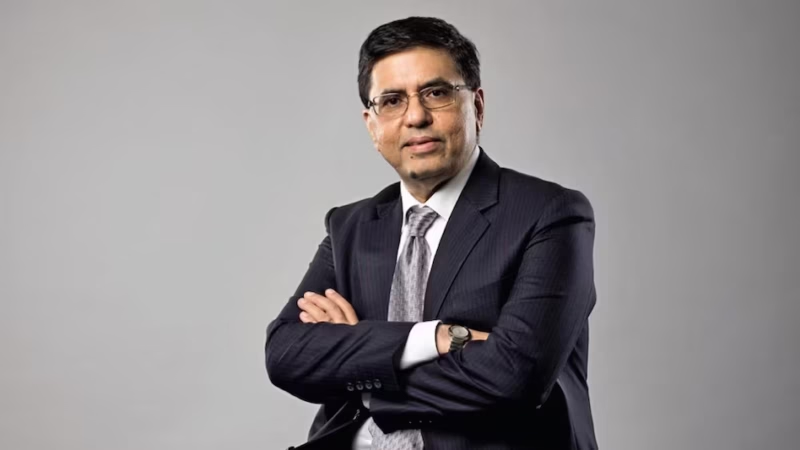
Sanjiv Mehta’s Vision: Rewriting the Rules of Corporate Governance in India
In a bold statement, Sanjiv Mehta, former CEO of Hindustan Unilever (HUL), shared his thoughts on what needs to change in corporate governance in India. According to Mehta, the focus must not only be on new regulations, but also on stronger execution, particularly through the integration of Artificial Intelligence (AI) and a multi-stakeholder approach.
As India navigates a rapidly changing business landscape, Mehta’s insights serve as a timely reminder that corporate governance needs to evolve alongside technology, shifting values, and growing expectations from both businesses and consumers.
AI: The Game-Changer for Corporate Governance
Mehta emphasized that the use of Artificial Intelligence could be a game-changer in improving governance standards. AI has the potential to reshape decision-making, enhance transparency, and reduce human bias in crucial corporate processes. Mehta believes that AI could be leveraged to monitor real-time compliance, assess risk, and even help in predicting future governance challenges.
By incorporating AI into governance frameworks, companies could:
- Automate compliance checks
- Analyze data for ethical risks
- Enhance decision-making processes, making them more data-driven and objective.
This could ensure that corporate governance not only keeps pace with technology but also leverages it to become more efficient and transparent.
The Need for a Multi-Stakeholder Focus
One of Mehta’s key recommendations is shifting from a shareholder-only focus to a multi-stakeholder approach in corporate governance. This means considering the interests of a broader group, including:
- Employees
- Customers
- Suppliers
- Communities
- Environmental groups
As Mehta points out, businesses today need to align their goals with societal interests. Corporations cannot simply operate for profit alone; they must also address social issues, environmental impact, and long-term sustainability. The growing emphasis on Environmental, Social, and Governance (ESG) principles is proof of this shift.
The Role of Diversity and Independent Boards
Another critical aspect of strengthening corporate governance is improving board diversity and ensuring independence. Mehta pointed out that having a more diverse and independent board is crucial for:
- Better decision-making that reflects a wider range of perspectives
- Increased accountability for company actions
- Stronger governance practices, particularly in times of crisis or major corporate challenges
Diversity isn’t just about gender or ethnicity—it’s about bringing in diverse skills, experiences, and viewpoints to ensure that boards are equipped to tackle modern business challenges.
Regulatory Action and the Need for Better Execution
While Mehta acknowledges that India’s regulatory framework has improved over the years, he stresses that better execution is key to enhancing corporate governance. New rules and guidelines are only effective if they are enforced properly. This requires stricter regulatory actions and ensuring that companies are held accountable for failing to meet governance standards.
Mehta suggests that there must be a stronger commitment from regulatory bodies to:
- Ensure companies follow the rules
- Penalize non-compliance
- Foster a culture of ethics and accountability across the corporate world
ESG Principles: A Vital Pillar of Corporate Governance
As the global business world increasingly embraces ESG (Environmental, Social, Governance) principles, Mehta advocates for a stronger alignment between corporate governance and ESG practices. He believes that companies in India need to integrate ESG into their core operations, not just as a marketing tool, but as a genuine, long-term commitment to sustainability.
By aligning governance structures with ESG objectives, companies can:
- Enhance long-term value creation
- Meet stakeholder expectations
- Contribute positively to society and the environment
The Future of Corporate Governance in India
Sanjiv Mehta’s thoughts on corporate governance provide a blueprint for how India can adapt to global trends while strengthening its business ecosystem. By embracing AI, focusing on a multi-stakeholder approach, fostering diverse and independent boards, and aligning with ESG principles, companies in India can build a more robust and sustainable governance framework.
The future of corporate governance is not just about following the rules—it’s about leading with integrity, transparency, and a commitment to all stakeholders. For India, the time to act is now.