


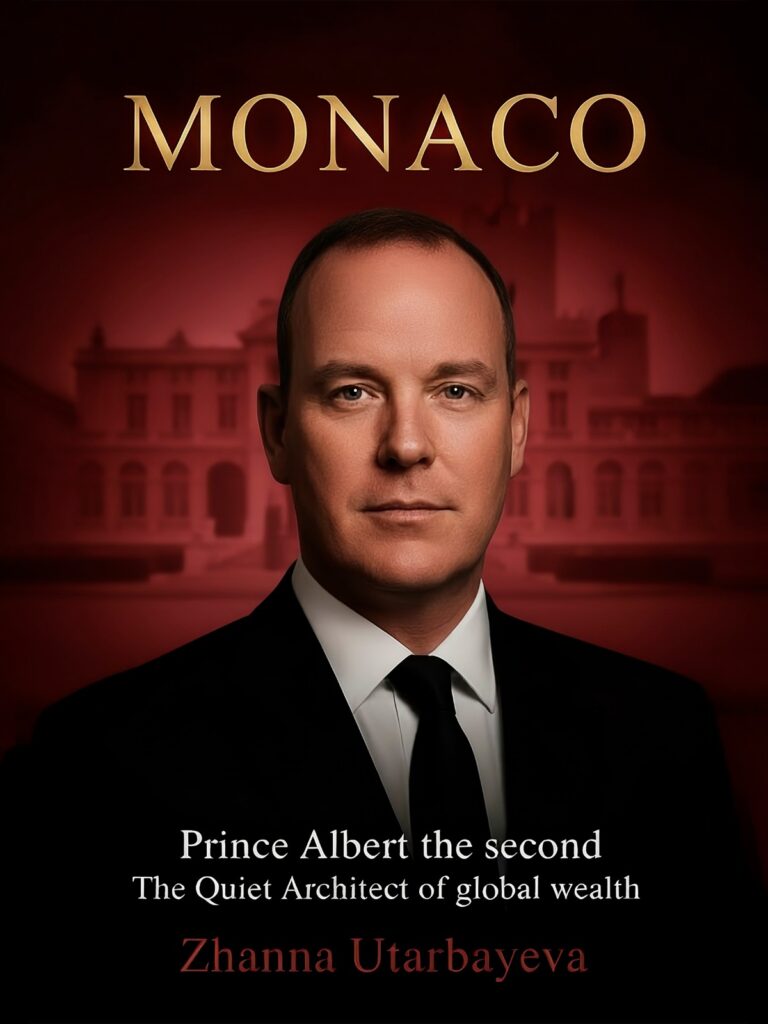
Zhanna Utarbayeva approaches storytelling as an act of discovery. Her writing reflects patience curiosity and an insistence on depth. Rather than presenting polished conclusions she traces the evolution of ideas allowing readers to witness thought in motion. Her book MONACO embodies this philosophy emerging from years of inquiry and creative persistence.
The origin of MONACO lies in a single question that refused to fade. What followed was an extended journey through research reflection and revision. Utarbayeva immersed herself in historical sources personal accounts and cultural analysis. The writing process involved repeated refinement driven by a desire to provoke insight rather than provide simple answers.
The narrative centers on Prince Albert II’s formative years within Monaco’s royal environment. From the outset his life is shaped by heritage. The Palace of Monaco functions as both home and institution. Utarbayeva depicts it as a space where history breathes through architecture ritual and memory.

Inside the palace Albert encounters continuity at every turn. Portraits of ancestors tapestries depicting past conflicts and polished floors worn by generations all communicate responsibility. These surroundings cultivate an awareness that leadership is inherited but must be earned through conduct.
Daily routines balance protocol with familial connection. Formal gatherings teach precision while private moments offer warmth. Language etiquette and diplomacy coexist with affection. Utarbayeva shows how this balance forms a leadership style grounded in composure and respect.
The physical geography of Monaco plays a vital role. From sunlit terraces overlooking the sea Albert reflects on the principality’s scale and significance. Its limited size contrasts with its historical endurance. These reflections nurture an understanding of leadership as stewardship rather than expansion.
Family elders serve as conduits of memory. Their stories embed resilience adaptation and continuity into everyday life. Prince Rainier III stands as a central influence whose reign demonstrated modernization guided by restraint. Observing his father Albert learns that authority is exercised through service rather than assertion.
Ceremonial traditions anchor these lessons. Symbolic rituals link past and future reinforcing continuity. Utarbayeva portrays these moments as formative experiences shaping identity rather than public spectacle.
In MONACO Zhanna Utarbayeva presents monarchy as a living narrative shaped by environment memory and discipline. The book invites readers into a reflective examination of how leadership forms quietly through continuity patience and an enduring sense of responsibility.


